Object.create和{}的区别
在 Vue 源码中,创建新对象都使用了
Object.create(null),而没有使用{}。
在很多社区也都因为这个话题讨论过,特此记录一下。
Object.create():
定义:
Object.create()方法创建一个新对象,使用现有的对象来提供新创建的对象的__proto__。
语法:
Object.create(proto[, propertiesObject])
参数:
- proto
新创建对象的原型对象。
- propertiesObject
可选。如果没有指定为undefined,则是要添加到新创建对象的不可枚举(默认)属性(即其自身定义的属性,而不是其原型链上的枚举属性)对象的属性描述符以及相应的属性名称。这些属性对应 Object.defineProperties()的第二个参数。
返回值:
- 一个新对象,带着指定的原型对象和属性。
例子(MDN):
const person = {
  isHuman: false,
  printIntroduction: function () {
    console.log(`My name is ${this.name}. Am I human? ${this.isHuman}`);
  }
};

const me = Object.create(person);

me.name = "Matthew"; // "name" is a property set on "me", but not on "person"
me.isHuman = true; // inherited properties can be overwritten

me.printIntroduction();
// expected output: "My name is Matthew. Am I human? true"
Object.create()和{}的对比::
{}:
例子:
let a = {o: 24};
console.log(a);
output:
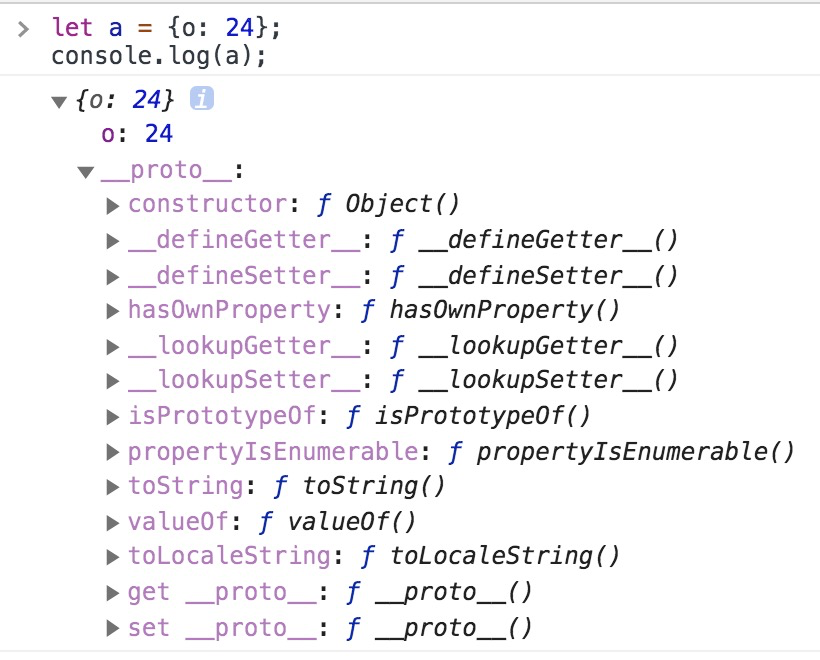
从上图可以看到,使用{}新创建的对象,继承了Object自身的属性,例如hasOwnProperty、toString等,在新对象上可以直接使用。
Object.create():
例子:
let o = Object.create(null, {
  a: {
    writable: true,
    configurable: true,
    value: 24
  }
});
console.log(o);
output:
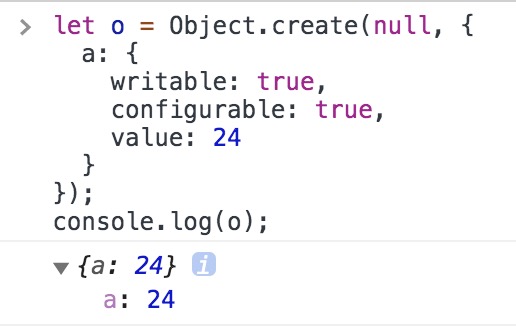
由上图可见:新创建的属性,只有个自身一个属性a,其原型链上没有其他任何属性。也就是没有继承Object任何属性。若此时我们访问o.toString()会报错Uncaught TypeError。
将第一个属性null改成{}:
let o = Object.create({}, {
  a: {
    writable: true,
    configurable: true,
    value: 24
  }
});
console.log(o);
output:
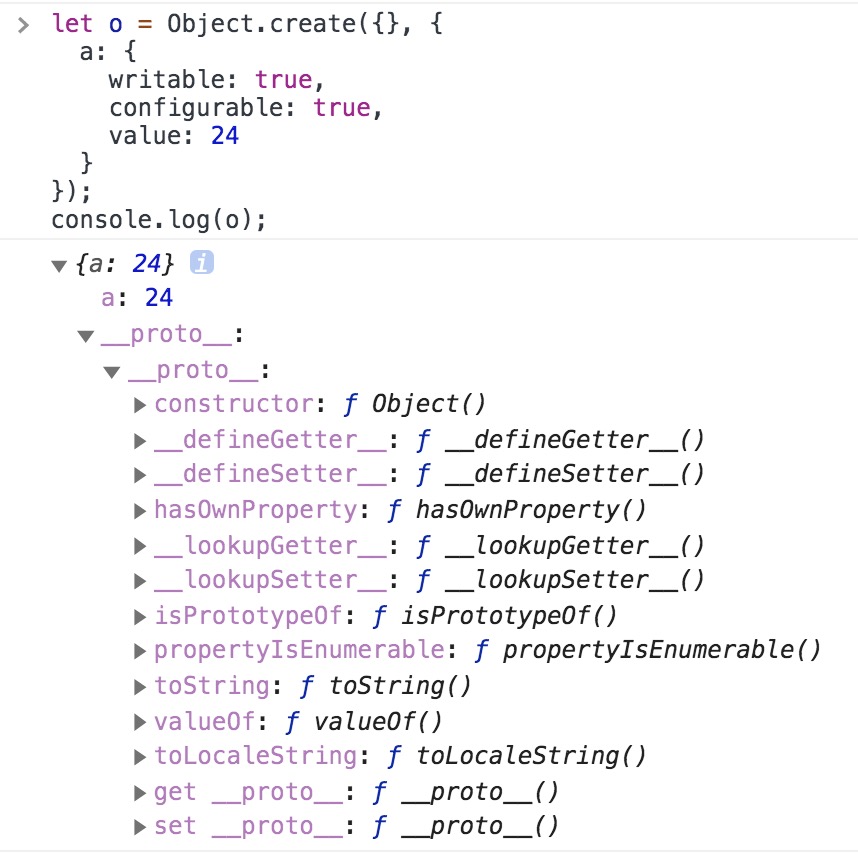
此时不难发现,此时已经具有了和{}几乎一样的属性了,除了多了一层_proto_。
将第一个属性null改成Object.prototype:
let o = Object.create(Object.prototype, {
  a: {
    writable: true,
    configurable: true,
    value: 24
  }
});
console.log(o);
output:
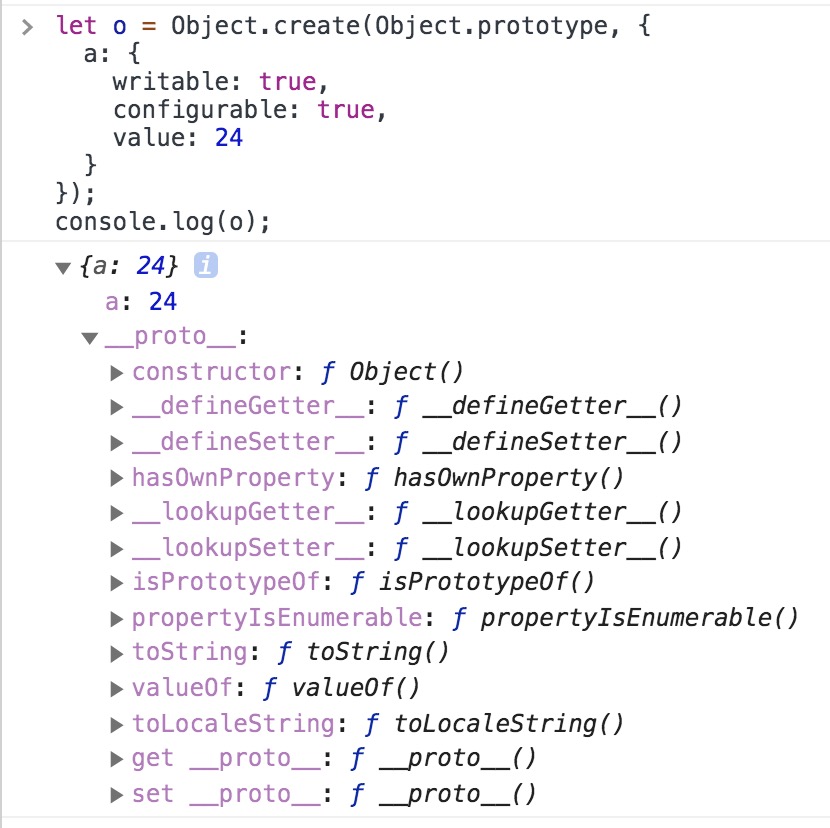
此时,已经和直接使用{}一样了。
为什么使用Object.create(null)?
代码:
Object.create(null);output:
{}
//No properties-
由此可见:使用这样的方式初始化一个新对象,没有任何属性,这样是一个比较纯净的
map。这样就可以自行扩展原型链的属性,同样包括原来既有的hasOwnProperty,toString这样的属性。 -
所以,使用
Object.create(null);,就不必担心原型链上的属性被覆盖。
平时大多的普通场景,两者的差距并不是很在意,统一风格就好。